

Continuous Innovation: The Best Guarantee for Winning the Market
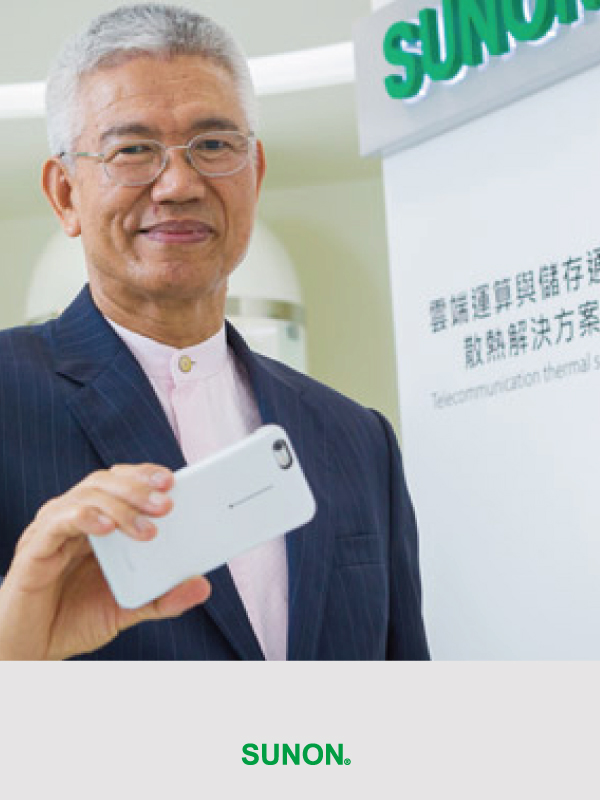
“If a phone only handled voice calls, things would be simple. But today’s smartphones connect to the internet, copy and sync data, and even project images. Even the human brain would overheat trying to process so many tasks at once, let alone a smartphone’s CPU,” pointed out Hung Yin-shu, Chairman of SUNON建準電機. Capitalizing on SUNON’s core expertise in micromotor technology, the company developed a protective smartphone case equipped with a built-in cooling fan module. This breakthrough breathed new life into SUNON’s product portfolio and paved the way into brand-new commercial territory.
Founded more than 35 years ago, SUNON建準電機 grew alongside Taiwan’s booming laptop industry. Its clientele spans major notebook ODMs such as Quanta and Compal. Nearly one out of every three laptops worldwide has been equipped with a SUNON cooling fan, establishing the company as the global market-share leader. “Without SUNON manufacturing ultra-thin and lightweight cooling fans, Taiwan’s laptop industry could never have grown this fast,” Hung said with well-founded confidence.
However, the rapid emergence of smartphones in recent years has driven a major paradigm shift across the tech industry. SUNON needed to identify new opportunities in emerging sectors to remain at the forefront of technology trends. In 2014, supported by the Conventional Industry Technology Development (CITD) program, SUNON developed the “Smart Thermal Smartphone Case” to prevent overheating while maximizing performance and user safety.
Taking the First Step into System Integration
SUNON’s research revealed that starting from the second half of 2013, the surface temperature of some flagship smartphone models could soar to around 50°C. Testing with SUNON’s thermal case demonstrated a 10°C reduction in surface temperature, bringing the perceived temperature down to 40°C. Furthermore, SUNON established the “SUNON Reference Design (SRD)” framework, collaborating with clients to rapidly integrate smart thermal cases and extend the underlying technology and innovative applications into other product categories.
From a market perspective, Gartner estimated global smartphone sales at approximately 1.2 billion units in 2014, signaling substantial potential for smart cooling cases. Even assuming a single model sells 40 million units and high-end thermal cases capture just 0.5% of that volume, the resulting revenue could reach NT$300 million to NT$400 million.
For an R&D-focused company like SUNON建準電機, continuous technical breakthroughs are essential. “SUNON’s mass-produced millimeter-scale micro fans had a thickness of 3 mm. However, to fit inside a phone case, the fan had to be even more compact. We challenged ourselves and engineered an ultra-thin millimeter micro fan of just 2 mm,” explained Li Chen-hsueh, Director of the Strategic Development Division at SUNON’s R&D Center. Beyond the fan blade assembly, the motor had to be thinner and lighter than ever, pushing SUNON to new engineering heights through this project.
In system integration, the project helped SUNON uncover challenges it had never addressed before. “For example, the power converter must not cause reverse charging during power delivery, and it had to be extremely slim. These were issues we never encountered before entering system integration,” said Li. To enable fan speed control, SUNON also invested in software development resources to write embedded code tailored to consumer needs.
Facing Consumers: Incorporating Industrial Aesthetics into Design
While external observers might see this merely as a phone case with a built-in cooling fan, for SUNON建準電機 it marked a pivotal step in business model transformation. Li pointed out that SUNON traditionally served system integrators, designing strictly according to OEM specifications. Under this project, however, SUNON took full ownership of the end-to-end system design and integration.
Furthermore, SUNON historically operated primarily as a B2B supplier with little direct consumer exposure. This protective case was created directly for end-users, marking a major transition from a B2B framework to a B2C model.
Li noted that the Chinese name “建準” (Chien-Tsun) carries the meaning of “establishing standards” (建立標準). “We aspire to provide products our competitors cannot offer. While thermal phone cases are forward-looking and innovative, this initiative pushed SUNON from working behind the scenes for commercial clients to stepping forward to directly engage end consumers.”
To win over retail consumers, SUNON bolstered its industrial design capabilities, treating aesthetics as a core development requirement rather than focusing solely on engineering performance. “We applied this design-centric approach to other product lines as well, such as our LED ventilation fan launched in Taiwan this year. That product went on to win Germany’s iF Design Award—the very first design accolade in SUNON’s history!” Li said.
“To me, the greatest value of participating in the CITD project was the encouragement and validation it gave us,” Hung Yin-shu concluded. Through the development and design of this innovation, SUNON overcame significant technical hurdles and earned an international design award once thought out of reach. “It gave us the confidence to keep moving forward. That is the real value this program brought to our company.”
Source: Business Today (今周刊)