

NEWS
News center
What is the "fresh air system" that will be the future of air purifiers?
What is the "fresh air system" that will be the future of air purifiers?
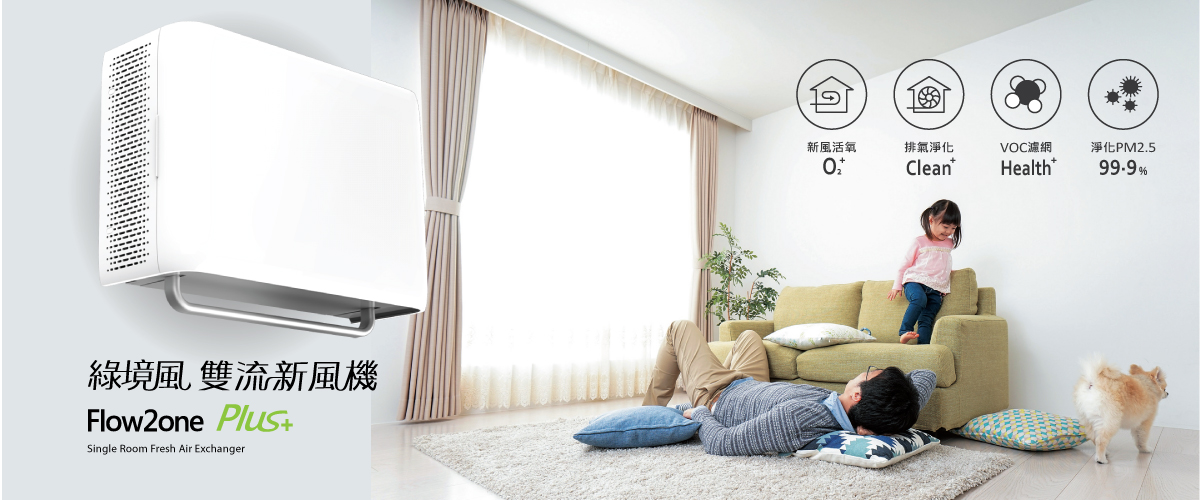
According to the sales data released by Xiaomi in 2018 during Taiwan's Double 11 shopping festival, air purifiers were among the top-selling products, with nearly 10,000 units sold in a short time. As the months of November to January correspond to the seasonal transition when air pollution is often more severe, this shows the growing awareness among people about the importance of preventing air pollution. However, in addition to the well-known PM2.5, "indoor carbon dioxide" is emerging as a new issue of concern, leading to the rise of "fresh air systems" in the market.
What are the health impacts of high indoor carbon dioxide concentrations? According to the "Indoor Air Quality Management Act" set by the Environmental Protection Administration (EPA), the recommended 8-hour average indoor carbon dioxide concentration should not exceed 1,000 ppm. Li Junzhang, Honorary Chairman of the Taiwan Indoor Environment Quality Society, states that when indoor CO2 levels exceed 1,000 ppm, people begin to feel fatigued and drowsy due to oxygen deprivation. If the concentration exceeds 4,000 ppm, it can even suppress the central nervous system, leading to problems such as lack of concentration, reduced judgment, and other issues, which could affect work efficiency and personal safety (such as while driving).
According to a study published in the 2015 "Labor and Occupational Safety and Health Research Quarterly," high indoor CO2 concentrations are quite common. In this study, CO2 concentrations in hospitals ranged from 900 to 1,400 ppm, while in MRT trains, buses, and long-distance coaches, concentrations were between 1,257 and 2,330 ppm, and in school classrooms, they ranged from 1,000 to 3,000 ppm—all above the recommended limit, indicating that indoor carbon dioxide pollution is a serious issue.
2 Major Advantages of Fresh Air Systems in Promoting Air Circulation and Balancing Indoor-Outdoor Temperatures
What exactly is a "fresh air system"? SUNON product manager, Qiu Bowei, explains: "To use a car's air circulation system as an analogy, an air purifier is like a car's internal circulation, while a fresh air system is like the external circulation." Air purifiers mainly focus on filtering PM2.5 in a fixed indoor space and do not have ventilation or oxygenation functions, and are more commonly used in enclosed spaces, which still leads to increased CO2 levels over time.
The key difference with fresh air systems is that they have an external vent to allow outdoor air to flow into the indoor space, increasing ventilation rates and reducing carbon dioxide levels. Additionally, they can be equipped with different types of filters, such as those for PM2.5 and odor removal.
In addition, fresh air systems have the following two benefits:
-
Prevents Dirty Air from Entering
Fresh air systems typically have larger air intakes. As indoor air pressure increases with the intake of fresh air, the air will flow out through gaps in doors or windows, which helps to circulate indoor air and prevents outdoor dirty air from entering through other openings. Dr. Chen Lingzhi, a researcher at the Institute of Information Science at Academia Sinica, suggests that fresh air systems should be installed diagonally opposite to doors to enhance air circulation. -
Dual-flow Fresh Air System with Temperature Regulation
Qiu Bowei explains that fresh air systems are generally divided into unidirectional and bidirectional types. Unidirectional systems only draw outdoor air into the indoor space and lack temperature regulation functions. For example, if the system continuously draws in hot outdoor air while the air conditioning is running, it will increase the energy consumption of the AC. However, bidirectional fresh air systems have the additional function of exhausting indoor air, which helps balance the indoor and outdoor temperatures.
Although fresh air systems can also function as air purifiers, Dr. Chen Lingzhi mentions that their use is still mainly limited to larger spaces with more people (e.g., schools) and has not yet been widely adopted in everyday life. He attributes this to two limitations:
-
Installation Requires Drilling Holes
Since fresh air systems need an external vent to allow for air exchange, installation requires drilling holes in the wall. This may not be acceptable for everyone, especially in Taiwan’s humid climate, as it could damage the structure or cause wall dampness. However, Dr. Chen suggests that for those who do not want to drill holes, an alternative is to install the system on windows, especially on horizontally sliding windows, which are more suitable for this type of installation. -
Faster Filter Wear
Whether unidirectional or bidirectional, fresh air systems introduce outdoor air into the indoor environment, which naturally increases the load on the filters and accelerates their wear.
However, Dr. Li Junzhang mentions that many manufacturers are already developing new models of fresh air systems suitable for different room sizes and environments, or improving existing air purifiers. He predicts that in the near future, the use of fresh air systems could expand to places such as movie theaters, KTVs, libraries, exam rooms, gyms, and even in vehicles, greatly increasing their application range.